Paris Cafe Vector Art with Beret Review
As a designer who spends more time staring at stitch simulations than actual cityscapes, I approach every new machine embroidery design with a critical eye. It is not enough for a graphic to look cute on a screen; it must survive the transition from digital Graphics to physical thread. Recently, I evaluated the Paris Cafe Vector Art with Beret and collection for a potential boutique line, and my assessment focuses on how this specific Illustrations set performs when put under the needle.
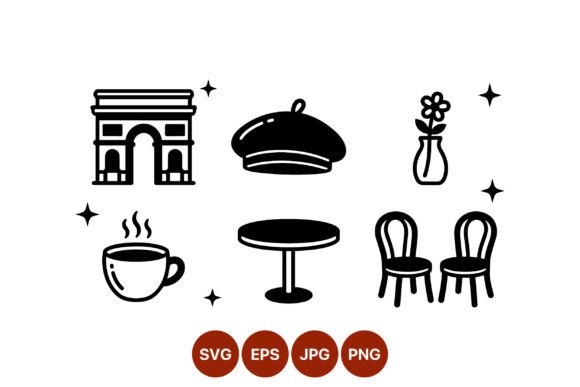
The first impression of this design is one of classic, understated charm. The black and white vector art featuring a paris cafe scene including the arc de triomphe, beret, steaming coffee cup, round table, two chairs, and a single flower in vase with sparkle accents creates an immediate mood of European nostalgia. For an embroidery project, this monochromatic foundation is a double-edged sword. On one hand, it offers incredible versatility for custom apparel where brand colors need to remain neutral. On the other, it demands precision. When you strip away color, the reliance on shape, negative space, and stitch density becomes absolute. There is nowhere for poor digitizing to hide.
Real-World Application: The Boutique Tote Scenario
To truly test the viability of this embroidery file, I envisioned a specific real-life scenario: a limited-run series of canvas tote bags for a local coffee shop's anniversary. The goal was to create a handmade product that felt elevated yet accessible. The Paris Cafe Vector Art with Beret and seemed perfect for this. The inclusion of the Arc de Triomphe provides a recognizable landmark, while the intimate setting of the round table and two chairs suggests connection and leisure.
In this context, the design shines as a tote bag design. The linear elements of the chairs and the table legs translate well into running stitch or light fill stitch patterns, preventing the heavy buildup of thread that can warp canvas fabric. The steaming coffee cup adds a dynamic vertical element, drawing the eye upward. However, the "sparkle accents" mentioned in the description require careful handling. In a vector format, these might be simple geometric shapes, but in embroidery, they risk becoming lost unless converted into high-contrast satin stitch details or perhaps even a metallic thread application. If handled poorly, these sparkles could look like stray stitches rather than intentional flair.
Performance Across Different Substrates
One of the strongest assets of this design is its adaptability across various fabric texture types. Because the core imagery relies on strong silhouettes—the beret, the vase, the architectural curve of the arch—it holds up well on textured materials like Terry cloth for holiday embroidery projects or kitchen towels. The bold outlines prevent the image from getting swallowed by the loops of the towel.
However, caution is advised when applying this to stretchy fabrics. If you are attempting sweatshirt embroidery on a fleece blend, the density of the Arc de Triomphe details could cause puckering if the stabilizer isn't robust enough. I would recommend a cut-away stabilizer for any garment that will undergo frequent washing, ensuring the structural integrity of the finished product remains intact over time. Similarly, for baby embroidery, such as a onesie or bib, the detail level must be scrutinized. Tiny elements like the single flower in the vase might need simplification to ensure they do not become scratchy or unravel with infant movement.
For those interested in creating an embroidered patch, this design is a strong contender. The distinct separation between the foreground elements (the cafe table) and the background (the Arch) allows for a clean merrowed edge or a laser-cut finish. This makes it an excellent candidate for small shop product lines where patches are a popular, low-overhead item.
Critical Considerations for the Professional Embroiderer
While the aesthetic appeal is undeniable, practical execution requires attention to several technical factors. The black and white nature of the source Illustrations means the burden of contrast falls entirely on your thread choice. If stitching on a dark garment, you cannot simply use black thread; you must invert the design logic, perhaps using cream or gold thread to maintain the "white" parts of the vector art. This requires a mental shift from the digital preview to the physical reality.
Furthermore, the hoop size is a limiting factor often overlooked in vector-to-stitch conversions. The panoramic nature of a cafe scene with a distant landmark implies width. Before committing to a production run, you must verify the maximum dimensions of the digital embroidery file. If the design is too wide for a standard hoop, you may face alignment issues or be forced to split the design, which ruins the seamless flow of the scene.
Special care must be taken with curved surfaces, such as caps. The horizontal lines of the table and the horizon line of the street scene can distort significantly on a curved brim. For cap projects, I would suggest isolating the vertical elements, such as the beret and the coffee cup, and perhaps omitting the wider landscape elements to maintain visual clarity.
Enhancing Brand Value and Customer Trust
From a business perspective, the Paris Cafe Vector Art with Beret and design carries a certain sophistication that can elevate brand perception. For an Etsy seller or creative entrepreneur, offering a product with this level of thematic coherence signals professionalism. It moves beyond generic clipart into the realm of curated design assets. Customers recognize the effort involved in selecting a cohesive scene rather than a random assortment of icons.
This design supports commercial embroidery ventures effectively because it taps into the perennial popularity of Parisian themes without being overly cliché. The specific inclusion of the beret and the intimate table setting adds a human touch that resonates with buyers looking for personalized gift options. Whether it is for a wedding gift commemorating a trip to France or a housewarming present for a coffee lover, the emotional resonance of the image adds value to the physical item.
Final Designer Notes and Recommendations
Before integrating this design into your workflow, I strongly advise running a test stitch-out on scrap fabric that matches your intended final material. Pay close attention to the "sparkle accents" and the fine details of the flower vase. Ensure that the thread colors you select provide sufficient contrast against your base fabric. If you are planning to sell these items, double-check the licensing terms associated with the download. While the description indicates it is available for download, confirming whether it covers commercial embroidery rights is essential to avoid legal pitfalls.
Additionally, consider creating printable mockup previews for your customers. Since the original art is black and white, showing potential clients how the design looks in different thread palettes (e.g., navy and white, red and cream) can help them visualize the custom apparel possibilities. Do not assume the black and white vector is the only option; use it as a blueprint for creativity.
In conclusion, the Paris Cafe Vector Art with Beret and is a robust choice for designers who understand the nuances of translating vector lines into thread. It offers a charming narrative quality that fits well within the current market trends for cottage-core and travel-inspired aesthetics. With proper stabilization, thoughtful thread selection, and a clear understanding of its dimensional limits, this design can be the centerpiece of a highly successful craft business collection. It is a reminder that in embroidery, as in life, the smallest details—the steam on the cup, the tilt of the beret—often make the biggest impact.