Review: No Smoking No Walking No Food No Bike No Set
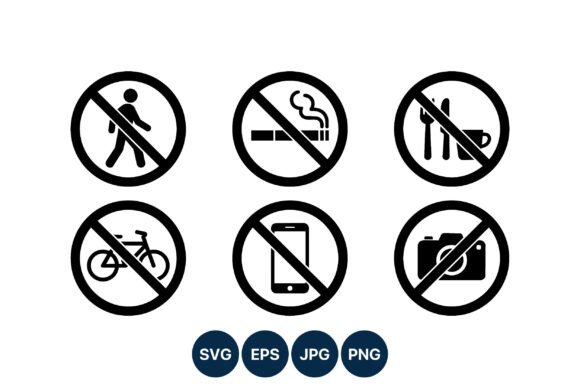
As a designer who spends more time at the embroidery machine than away from it, I approach new design assets with a healthy dose of skepticism. We have all downloaded a file that looked crisp on the screen but turned into a bird's nest of thread once the needle hit the fabric. That is why I took a close look at the No Smoking No Walking No Food No Bike No collection before committing it to any client work. This set of six black and white vector signs—covering smoking, walking, food, biking, phones, and cameras—isn't just a digital download; it is a potential staple for functional handmade products.
First Impressions and Visual Personality
When you first open the files, the immediate takeaway is clarity. These are not overly ornate illustrations meant for display art; they are utilitarian graphics designed to communicate rules quickly. The mood is strict yet clean. In the world of machine embroidery design, simplicity is often your best friend, especially when dealing with prohibition symbols where recognition is key. The layout of each icon within the universal "no" circle feels balanced. There is no unnecessary clutter that would force you to increase stitch density to unnatural levels, which is a common pitfall in small-scale digitizing.
The visual personality here is bold and authoritative. Whether you are stitching these onto a staff apron or a custom tote, the message needs to be instant. The No Smoking No Walking No Food No Bike No set achieves this through strong lines and high contrast. As an Etsy seller or boutique owner, you want your customers to understand the product's function immediately, and these graphics deliver that instant recognition without needing extra explanation.
Real-World Application Scenarios
To truly test the viability of this collection, I imagined a specific project: a line of heavy-canvas tote bags and denim aprons for a local café and co-working space. These venues often need subtle but firm reminders about their policies. Using the embroidery file for the "no food" icon on a barista apron pocket creates a professional boundary without being rude. Similarly, the "no phone" and "no camera" signs are perfect for lining the inside of a yoga studio bag or stitching onto a pillow cover in a private lounge area.
For custom apparel, these designs shine on sweatshirts and caps. Imagine a sweatshirt embroidery project for a cycling club where the "no bike" symbol is used ironically on a warm-up jacket, or perhaps seriously on a gear bag to mark a non-riding zone. The versatility extends to baby embroidery as well; a "no food" patch on a bib is both functional and cute, provided the scale is adjusted correctly. For holiday embroidery gifts, these could be stitched onto kitchen towels as a humorous housewarming present for a friend who is strict about their kitchen rules.
The potential for commercial embroidery is significant here. Small shop owners can use these to brand merchandise that aligns with their store policies. A skateboard shop might sell patches featuring the "no walking" or "no bike" icons as part of their streetwear line. Because the source files are vectors, they fall under the category of scalable Illustrations and Graphics, meaning you can resize them for anything from a tiny chest logo to a large back patch without losing definition, assuming your digitizer has converted them properly for stitching.
Technical Considerations for Stitching
While the design concept is solid, the execution depends entirely on how the vector art is translated into stitches. When working with prohibition signs, the circle and the diagonal slash are critical. If the stitch density is too low, the circle will look jagged. If it is too high, the fabric will pucker, especially on stretchy materials like t-shirts. I recommend testing these on scrap fabric first. Pay close attention to the diagonal slash; it needs to be wide enough to hold a satin stitch or a tight fill stitch without collapsing.
Fabric texture plays a huge role in how the No Smoking No Walking No Food No Bike No set performs. On textured fabrics like Terry cloth or heavy canvas, fine details like the cigarette smoke or the tines of the fork in the "no food" icon might get lost. In these cases, you may need to simplify the internal details or switch to a running stitch outline if the design allows. For dark fabrics, ensure your thread colors provide enough contrast. White or silver thread on navy or black works well, but always check the visibility of the diagonal bar.
Hooping is another factor. If you are applying these to curved surfaces like caps, ensure your hoop size accommodates the curvature without distorting the circular shape of the prohibition sign. A distorted circle looks unprofessional and undermines the authority of the sign. Also, consider the stabilizer. For items that will see frequent washing, like aprons or tea towels, a cut-away stabilizer is usually safer than tear-away to prevent the design from shifting or puckering over time.
Impact on Brand and Customer Trust
Using professional-grade signage in your embroidery projects elevates the perceived value of the finished product. When a customer sees a cleanly stitched "no camera" sign on a VIP event bag, it signals attention to detail and professionalism. It builds trust. Conversely, a poorly executed design with gaps in the stitching or misaligned layers can make a business look amateurish. The No Smoking No Walking No Food No Bike No set, when stitched correctly, reinforces brand consistency. It tells the end-user that the creator cares about clarity and quality.
For those creating printable mockups or digital product previews, these icons add a layer of realism. They help potential buyers visualize the final application, whether it is a patch for a backpack or an emblem on a uniform. This visual clarity drives buyer engagement and can be the difference between a scroll-past and a purchase.
Designer Notes and Final Verdict
Before you start stitching, there are a few practical steps to take. First, verify the license terms. While the description mentions a download including vectors, always confirm if the digital embroidery file version allows for commercial use if you plan to sell the physical items. Second, inspect the small details. The "no phone" icon, for instance, has small buttons or screen details that might need adjustment depending on your thread weight. Third, test the design in both black and white mockups to ensure the contrast holds up regardless of the thread color chosen.
Ultimately, the No Smoking No Walking No Food No Bike No collection is a practical, versatile tool for the modern maker. It bridges the gap between necessary regulation and creative expression. Whether you are an applique design enthusiast looking to create layered patches or a decorator focusing on direct stitch work, this set offers a solid foundation. Just remember to respect the limitations of your machine and fabric, and these graphics will serve your craft business well for years to come.